
We've become accustomed to an unfortunate law of nature in product development: The more beautiful a design is, the more fragile it often is. A polished black surface on an expensive watch or a minimalist grip on a piece of luxury electronics looks great in the display window. But after a few months of use, scratches and worn edges tell a different story.
But this “law of nature” has been broken. Premium brands in super sports cars, high-end audio and luxury design no longer accept scratches as an inevitable part of the user experience. They demand surfaces that retain their original, flawless appearance year after year.
This is where traditional coatings fall short. If you design a product in the high-end segment, your customers expect perfection. Every time a product loses its finish due to daily wear and tear, the brand's reputation suffers. This is exactly why the luxury design segment is currently undergoing a massive technology shift.
The solution is contained in a vacuum chamber.
The Invisible Shield: What Makes PVD Coating So Unique?
The secret behind the market's most resistant design products is called PVD (Physical Vapor Deposition).
In practical terms, PVD is an advanced surface treatment that takes place under vacuum. Instead of dipping the object, a surface coating consisting of a chemical compound formed from metal and gas – for example, chromium nitride – is vaporized.
The result? An extremely durable layer on the surface of the workpieces. This process creates a PVD coating that is significantly harder and more durable than coatings applied solely via traditional galvanic processes.
Technically, the technology is distinguished by a typical layer thickness of just between 0.1 and 4.0 µm. The layer covers the object at such a fine micrometer level that you get impenetrable protection that changes absolutely nothing about the product's original tolerances or fine design lines.
The Hybrid Method: The Best of Both Worlds
Many designers mistakenly believe that you have to choose between PVD and traditional electroplating. This is not true. In fact, the absolute strongest results are achieved by combining the technologies.
By applying a galvanic undercoat and then finishing with a decorative PVD coating on top, a hybrid solution is created. The galvanic base ensures excellent corrosion properties, while the PVD topcoat delivers the unrivaled hardness and final visual finish. It is this combination that allows components in super sports cars to withstand extreme environments while looking stunning. At Chem-tec Plating, we are experts in combining galvanic plating and PVD, and both technologies are available in-house.
A strategic farewell to black chrome
The development of high-end design is incredibly fast, but it is not only aesthetics and durability that are driving the changes. The entire industry is facing a regulatory shift. The EU has long been struggling with a ban on the use of Hexavalent chromium (Chromium VI / Cr(VI)), which has traditionally been used in many older surface processes.
To stay ahead of the law and meet the demanding demands of premium brands, we at Chem-tec Plating have invested heavily in PVD technology. This early investment has now made us the leading player in Northern Europe specializing in decorative PVD. Our position in the market is based on offering a wide range of specialized solutions and having an enormous insight into both the challenges designers face and the technical solutions required to solve them.
Technological and environmental developments mean that we must dare to let go of the past. That is why we made a significant decision ahead of 2025: We completely shut down our production of traditional galvanic black chrome.
CEO of Chem-tec Plating, Bo Hvid Mikkelsen, puts into words the strategy behind the investment:
“The decision was made from two perspectives. Firstly, we knew that the EU’s upcoming ban on Hexavalent Chromium (Cr(VI)) would change the industry permanently, and we wanted to ensure that our customers were at the forefront of developments. Secondly, we saw an incredibly exciting and attractive market in decorative plating. Customers in the luxury segment demand surfaces that are visually flawless and extremely durable, without compromise. That is why we have invested heavily in PVD plants and know-how and have chosen to phase out the old galvanic black chrome in favor of a technology that is both future-proof and delivers a superior finish.”
PVD is an upgrade in terms of quality, design and environmental impact.
Aesthetic freedom: From shiny gold to matte black
Although black chrome is one of our most popular solutions, the possibilities don't stop there. At Chem-Tec Plating, we offer PVD plating in a range of exclusive colors: Chrome, black chrome, gold, brass and copper.
The colors are created by varying the source material in the vacuum chamber. While classic chrome and black chrome are formed with chromium as a base, the warm shades such as gold, brass and copper are created using zirconium.
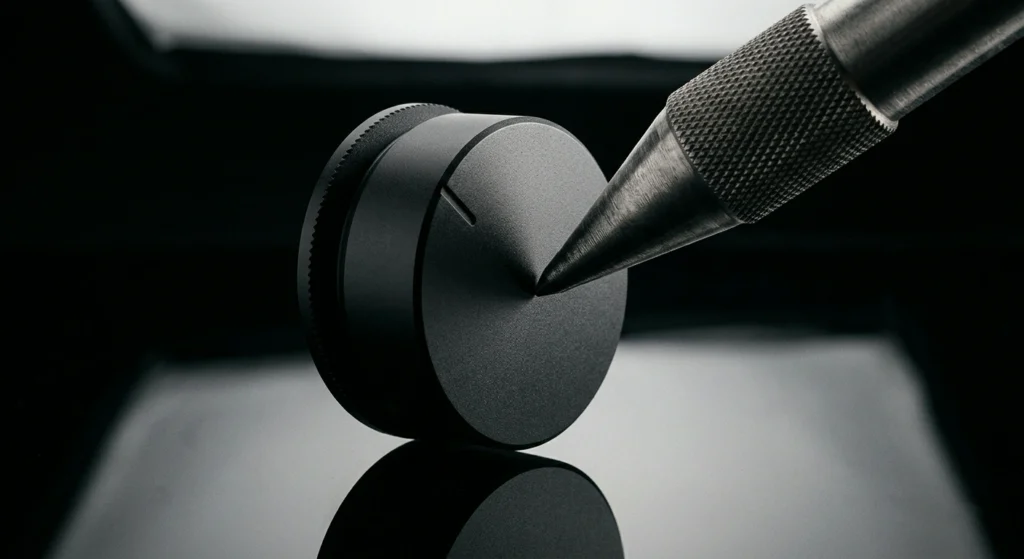
The standard expression for our PVD coatings is a beautiful, glossy surface that reflects light perfectly. But if your design requires a more subdued, industrial or minimalist look, we also have the solution: We can glass-blow the items before they are surface-treated with PVD. The result is an exclusive, matte surface that combines the extreme strength of the technology with exactly the finish your brand calls for.
Three reasons why high-end brands choose PVD:
If you work with product development within luxury electronics or premium design, PVD gives you three very concrete advantages:
- Extreme scratch resistance: PVD coatings have a hardness that far surpasses traditional metals. Your product will retain its newly designed look.
- Flawless aesthetics: The process ensures a completely even color distribution. Whether you want a deep matte black or a mirror-like finish, the result will be consistent every time.
- Chemical resistance: PVD does not react with sweat, salt water or most cleaning agents, making the coating ideal for everything from high-end watches to automotive touch panels.
Imagine the products of the future
Try to think five years ahead. A customer has purchased your latest high-end audio system. After thousands of touches, cleanings, and daily use, it still sits razor-sharp in the living room. The buttons shine. The black surface is free of hairlines and wear.
It's not just a question of a nice design. It's a question of delivering a quality that justifies a premium price. By integrating Physical Vapor Deposition into your production chain, you remove the friction between beautiful design and everyday usability.
Ready to take your next design project to the next level? Contact our specialists for a no-obligation discussion about how our PVD and hybrid solutions can be integrated into your future components.
 EN
EN  DK
DK  DE
DE