
We spend millions developing bug-free software. We stress test code until it breaks.
Yet the physical hardware that connects these brilliant systems is often treated as an afterthought.
A microscopic surface defect on a basic electronic component can bring a massive industrial system to a complete standstill. You can write the best algorithms in the world, but if the physical connection fails, the machine fails.
Less and less margin for error
Electronic devices are rapidly becoming smaller.
IoT sensors, automotive components, and high-frequency communication tools are getting smaller year by year. As these devices get smaller and smaller, the physical connections are also getting smaller.
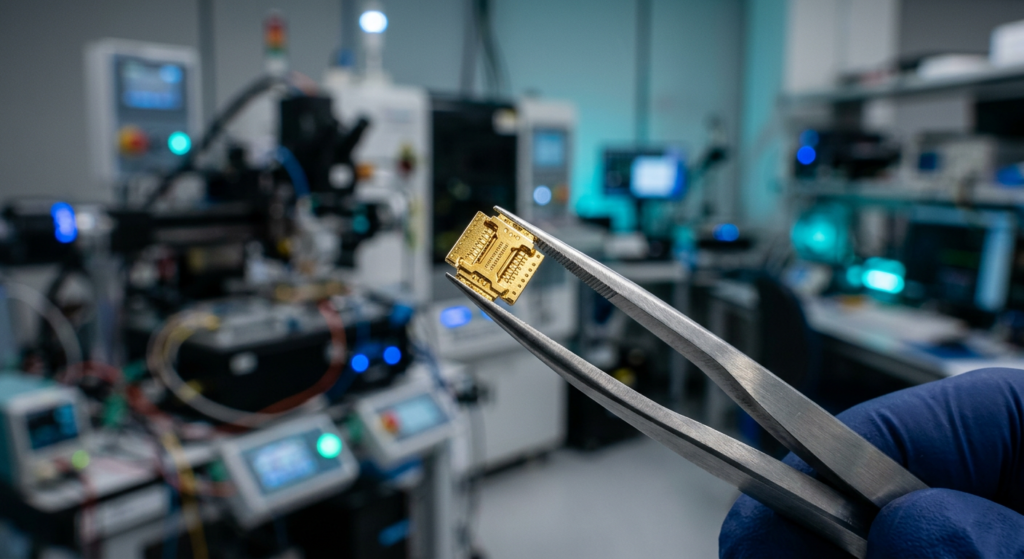
This creates a massive engineering challenge.
A micro-connector has a tiny surface area to maintain electrical conductivity. If that surface oxidizes or degrades even slightly, the signal drops out.
In a controlled laboratory, a signal dropout is annoying. In the field – whether in a moving vehicle, a remote telecom tower, or a critical industrial sensor – it causes catastrophic system failure.
The Illusion of “Gold Plating”
Many hardware engineers write “Gold Plating” on a production drawing and assume the problem is solved.
That is a dangerous assumption.
Gold is an incredible material. It offers phenomenal conductivity and high corrosion resistance. But if you apply gold directly on top of a base metal like copper, you set a trap.
Over time, copper atoms migrate right through the gold layer. This process accelerates in hot or humid environments. When the copper reaches the surface, it oxidizes. The contact resistance skyrockets. The connection silently fails.
To stop this, you need a flawless barrier layer – usually nickel – to lock the base metal in place before the gold is applied.
Precision is the only parameter that counts
The physics behind contact resistance doesn't lie.
“Studies show that without a proper barrier layer, diffusion of base metal can increase contact resistance exponentially within a few months. Electronic equipment often needs to last for years without degradation.
At Chem-tec Plating, we know that technical surface treatment requires absolute precision. You can't guess. You have to measure.
Our ISO 9001 certified processes have a strong focus on exact specifications. We use advanced X-ray fluorescence (XRF) to measure coating thickness down to the microscopic level. This ensures that both the nickel barrier layer and the final gold plating meet the precise requirements of the component.” — Bo Hvid Mikkelsen, CEO, Chem-tec Plating
Stop accepting generic specifications
You need to take full control of your technical specifications.
Stop accepting generic “gold finish” labels from suppliers. Define the exact thickness of your gold layer. Require a specific undercoat, such as nickel, that can act as a permanent barrier.
Require your surface treatment partner to provide documented measurement reports for every batch. Undocumented quality is no quality at all.
Let's review your specifications
Don't let a microscopic coating defect compromise your next major electronic device.
Are your component specifications truly optimized for long-term survival in harsh environments?
Let us review your surface treatment requirements and ensure your components are built to perform when it matters most.
 EN
EN  DK
DK  DE
DE