
The distance from Uldum to Hamburg is around 300 kilometres. The distance from Munich to Hamburg is almost 800.
That distance comes as a surprise to most people. It also says something about how a German buyer might view Denmark. For a company in northern Germany, a Danish supplier is closer than one in Bavaria. We are part of the same single market; there are no customs duties, and the regulations on chemicals are the same. We also handle the shipping and deliver door-to-door.
The gap is now at its narrowest. German companies have a reputation for being some of Europe’s most demanding customers, and it is a well-deserved reputation. We know this because we work with them every day. Among our 150 largest customers this year are German companies from five different sectors, and one of them ranks among our 15 largest customers.
They have taught us a great deal about what a supplier needs to be capable of.
The requirements go beyond the part itself
German industry has always prioritised quality. What is new is that the demands placed on suppliers today extend far beyond the component contained in the box.
Following several years of supply crises and containers failing to arrive, security of supply is now high on buyers’ list of priorities, right alongside price and quality. At the same time, customers want more documentation. They need to be able to show what has happened to a component along the way, and how the supplier handles chemicals, energy and waste. Since 2024, all German companies with at least 1,000 employees have been subject to the Lieferkettengesetz, and the EU’s Directive on due diligence in the supply chain (CSDDD) is on its way. Formally, the requirements apply to large corporate groups, but in practice the onus falls on the subcontractors.
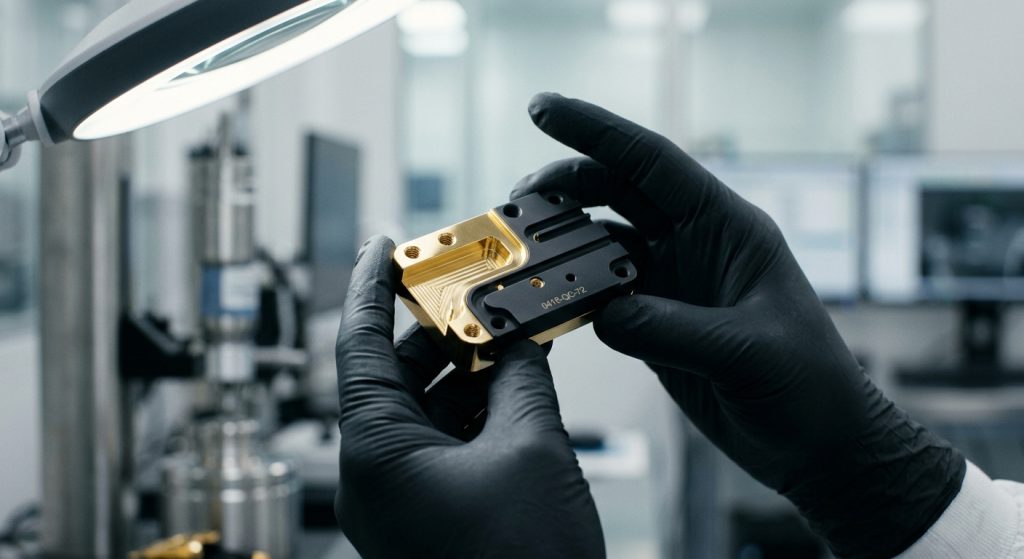
Surface treatment is a particularly vulnerable stage. The coating is often the final step in the process before the component is to be fitted. The part has already passed through a lathe, a milling machine and quality control at several different suppliers. If the gold plating on a connector is too thin, or if a PVD coating fails, it is therefore the entire supply chain that pays the price. We have written more about this in the article on cumulative process risk.
And every time a component has to be passed on to a new supplier, there is another point where things can go wrong.
What “Alles aus einer Hand” means in practice
In German, there is an expression for what most buyers dream of: Everything from a single source. Everything from a single source.
Many people see it as a convenience, because you receive a single invoice and have a single point of contact. In surface treatment, it has a more specific meaning, namely who is responsible for the transition between two layers.
Take PVD as an example. A PVD coating can be applied directly to stainless steel and titanium. If it is to be applied to copper, aluminium, steel or brass, a layer of electroplated nickel or pearl-finish nickel must first be applied. When the nickel and PVD are produced by two different suppliers, the parts must be packaged, transported and handled between the two stages. Each time, there is a risk of scratches and contamination, and every extra step takes time. And if the adhesion fails afterwards, the nickel supplier blames the PVD supplier, and vice versa. Meanwhile, the assembly line is on hold.
At Chem-Tec Plating, we apply the electroplated nickel and then the PVD coating on top, all under one roof and under the same quality control system. This also applies when a component requires both chemical nickel plating and electroplated coatings such as gold, silver, tin or tin/nickel. Chemical and electroplated surface treatments, as well as PVD, are all carried out under one roof in Uldum. The customer has one supplier to audit, one process to approve and one telephone number to call.
Five sectors with the same requirements
Our German customers manufacture a wide variety of products, but they have many of the same requirements when it comes to coatings.
- Professional audio and acoustics. Contact surfaces must have a low and stable contact resistance year after year. This typically requires gold on a nickel substrate, in precise layer thicknesses.
- Electrical protection and connection technology. The components must conduct electricity safely and be suitable for soldering without any problems, often in large production runs. Here, we work with tin, tin/nickel, silver and gold. For connector pins and contacts that only need to be plated on part of the workpiece, we have two reel-to-reel plating lines.
- Highly reliable electronics. A component cannot be replaced once the product has been put into use. That is why the documentation is just as important as the coating.
- Precision machining and toolmaking. German subcontractors send us finished workpieces because their own customers require a specific surface finish.
- Premium design products. Here, the surface is the first thing the customer touches, and this is where PVD in colours such as chrome, black chrome, gold, brass and copper really comes into its own.
We’d like to say a little more about the fourth group. When a German CNC company sends its customer’s parts to a Danish surface treatment specialist, it is putting its own reputation on the line. It doesn’t need a supplier it has to apologise to on behalf of the end customer.
Hidden champions think in terms of decades
The German economist Hermann Simon has spent much of his career studying what he calls hidden champions. These are medium-sized, often family-owned businesses that are world leaders within a narrow niche, but which few people outside the industry have heard of. According to Simon’s 2020 figures, 1,573 of the approximately 3,400 are based in Germany. That is almost half.
Several of our German customers fit that description. They rarely change suppliers, as they know what a change would cost in terms of new samples and approvals. In return, they expect the supplier to still be there in ten years’ time.
Robert Bosch, who founded Bosch, put it this way: “Better to lose money than trust.” Better to lose money than trust. That saying is particularly apt for a business like ours, where we make our living by achieving the same result time and time again, to within a thousandth of a millimetre.
We’ve been here since 1986, so we’re turning 40 this year. In the 1980s, we started coating printed circuit boards. In the 1990s and 2000s, we surface-treated billions of gold-plated springs for telephones. Every single one of them had to have the same layer thickness.
When we closed ‘Black Chrome’
Prior to 2025, we completely phased out our production of electroplated black chrome.
The reason for this was the EU’s forthcoming ban on hexavalent chromium, Cr(VI), on which traditional electroplated black chrome is based. We did not want to risk our customers being left with an approved finish that would suddenly no longer be permitted to be produced. So, rather than waiting for the legislation to come into force, we invested in PVD. The full story can be found in the article ‘When aesthetics meet engineering’.
We currently offer black chrome as a PVD coating, in both a glossy and a matt finish, on parts up to 800 mm in length and 300 mm in diameter.
German buyers take note of decisions like these. Security of supply is about ensuring that next week’s delivery arrives on time. But it is just as much about the supplier thinking five years ahead, so that the customer does not suddenly have to re-qualify a surface.
Sustainability is closely linked to this. We operate in accordance with the REACH Regulation and the RoHS Directive, and we publish an environmental report every year. The reports for 2023, 2024 and 2025 are available on our website. When a German customer needs to document their supply chain, they can use them directly.
Quality with ten years’ memory
We are certified to ISO 9001:2015. Our day-to-day quality management is carried out by our in-house laboratory.
Here, we analyse the process baths using, amongst other things, an atomic absorption spectrophotometer capable of measuring up to 67 elements. We also have a UV-VIS spectrophotometer, a metallurgical microscope with micro-sectioning equipment, and Hull cells. All analysis results and adjustments are stored in a database for at least ten years. Should any queries arise regarding a delivery several years later, the process data from that time will still be available in the database.
During production, we carry out continuous quality checks before, during and after processing. We can run test rolls as short as 20 metres on the production lines and several kilometres in series production, which makes the transition from prototype to series production easier to manage.
Advice before the subscription is finalised
German engineers are thorough, and they want answers at an early stage. That suits us fine. We achieve the best results when the customer contacts us whilst the component is still under development. That way, we can work together to assess how the geometry affects the coating, what layer thickness is required, and which coating is best suited to the task.
Sometimes an early discussion ends up changing the design of the component itself, not just the choice of metal. You can read more about this in ‘Give us a call before the design is finalised’.
Five questions for your next surface treatment specialist
If you’re in the process of choosing a new surface treatment supplier – whether it’s us or someone else – here are the questions we’d ask ourselves:
- How many suppliers does the component have to go through before it is finished?
- Can the supplier retrieve process data relating to a delivery from five years ago?
- Which of the supplier’s processes might be affected by forthcoming EU restrictions, and what is the plan?
- Do you receive advice before the subscription is finalised, or only once the order has been placed?
- Who organises the transport, and who is responsible if something goes wrong?
The answers reveal more about the supplier than the quoted price does.
From Uldum to your goods reception area
A connector can leave Uldum coated with nickel and gold – checked before, during and after the treatment – and be delivered door-to-door to your goods reception in Lower Saxony, North Rhine-Westphalia or Baden-Württemberg. At no point during the journey has it been handled by any other surface treatment provider. If you have any questions regarding the coating thickness, simply make one phone call, and the answer can be found in ten years’ worth of process data.
This is how we are already working with German clients across five sectors.
Do you have a component that currently has to go through several suppliers, or a surface finish that needs to be approved for a new production run? Please send us the drawing to info@chemtec.dk. We’ll treat it confidentially, and our technicians will assess which coating and layer thickness are best suited to the job. You can also call us on +45 75 67 92 92. We’re happy to assist with shipping and door-to-door delivery to Germany.
 EN
EN  DK
DK  DE
DE