
A customer standing in a showroom choosing a faucet never sees the brass inside. She sees and touches the outer layer: the color, the shine, and the feel under her fingers. That layer is more than decoration. For a kitchen or bathroom faucet, the surface is, to a large extent, the product itself, and it largely determines how the customer experiences the quality.
Yet the surface is often chosen at the end of the development process, even though it is one of the first things outsourced to a subcontractor. This is where many premium products lose value. The finish that sold the product in the showroom loses its luster or tarnishes after a short time, and the design that felt like a boost when you bought it ends up disappointing.
Three manufacturers, the same basic requirement
If you look at what manufacturers of premium fixtures emphasize most, a pattern emerges.
A design-driven manufacturer of drinking water and kitchen faucets lives by the expression. Dark tones like gun metal, deep gold nuances, a surface that matches the architect's materials. Here, the color is the product's signature.
An architectural design company working in acid-resistant stainless steel builds its reputation on material honesty and longevity. Solutions for high-traffic buildings, where replacement is a reality, but rarely should be the standard answer. Here the surface must be able to last for years without compromising the pure form.
A manufacturer of touchless sensor faucets for hospitals and commercial kitchens has hygiene at its core. Surfaces that are cleaned and disinfected over and over again, often with harsh chemicals, without causing damage or giving bacteria a place to settle.
The same requirement applies across the three products: The surface must hold a functional and visual promise at the same time, for many years.
The requirements look aesthetic. They are technical.
A color that must look the same across an entire production run and still look like itself after ten years of water and daily cleaning places demands that a purely galvanic coating can rarely meet on its own. That is exactly the task PVD is built for.
PVD, Physical Vapor Deposition, builds up the color as a thin film, typically between 0.1 and 4.0 µm. The process takes place in a vacuum, where the film condenses on the workpiece and forms a strong bond to the base material. With the right pre-treatment, the coating is so firmly attached that the risk of peeling is minimal. The result is a surface that is harder and more durable than a similar galvanic coating.
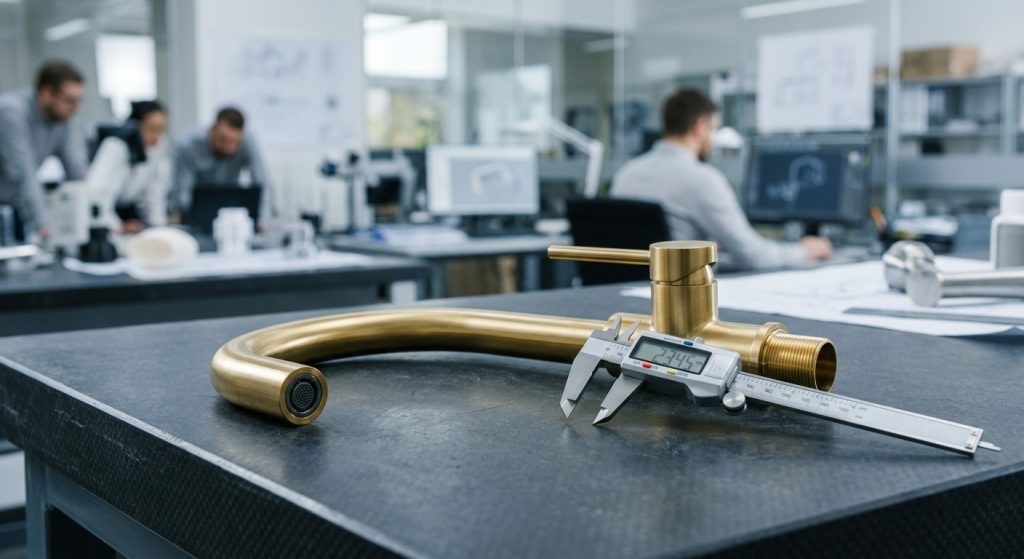
Chem-Tec Plating performs PVD coating in chrome, black chrome, gold, brass and copper, with a glossy surface as a starting point and a matte variant when the items are glass-blown inside. The material behind the fixture is no obstacle. PVD can be applied directly to stainless steel and titanium, and with a layer of nickel underneath it can also be applied to brass, the classic fixture material, as well as to aluminum, steel and copper. The actual corrosion protection comes from both layers: the PVD film protects in itself, and on a brass fixture the galvanic nickel undercoating reinforces the protection, while the PVD on top provides the hardness and color.
For all three manufacturers, the vastly different needs lead to the same solution. The design-driven manufacturer gets deep, consistent colors in glossy or matte. The stainless steel company can apply a hard finish directly to its preferred material. And the sensor manufacturer has a surface that is both decorative and resistant to wear and corrosion.
Five requirements a luminaire manufacturer should make
The choice of surface supplier is rarely the most visible decision for a product manager or quality manager. However, it is one of the most visible to the end customer. Five requirements separate a real partner from a supplier who just takes an order.
First of all, the functional and decorative aspects should be handled by the same supplier. A fixture must both look right and be able to withstand water and daily use. A supplier who masters both functional and decorative surface treatment and can combine coatings brings the two tasks together under one roof, so that the items do not have to be sent back and forth between several links.
Next, flexibility in materials counts. Stainless steel in one place, brass in another. A supplier that can both apply PVD directly to steel and build the right galvanic substrate under a brass part covers the entire product portfolio without the manufacturer having to find a new partner for each material.
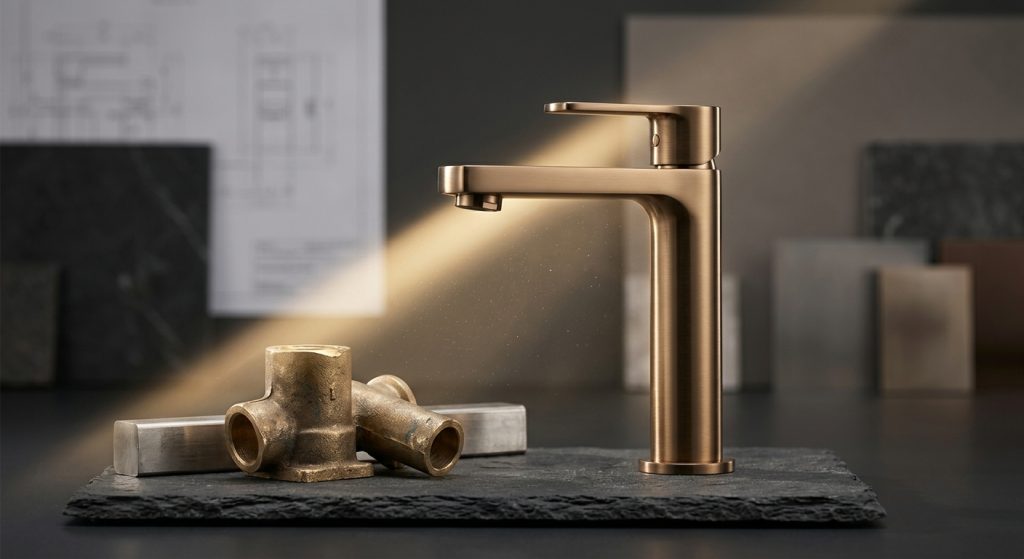
The third requirement is a development partner who is involved early on. PVD is a line-of-sight process: the vapor only coats the surfaces it has direct access to, and the workpiece rotates around two axes to strike as evenly as possible. For a fixture with internal channels and tight corners, this means that geometry and suspension help determine how uniform the finish will be. It is cheapest to take this into account before the molds are set. Chem-Tec is often involved early in the development process, so the surface is considered from the beginning, and this gives an R&D or product manager fewer expensive surprises late in the process.
The fourth point is advice that is based on the subject. A strong supplier asks what the subject should be able to do, and recommends the coating that suits both function and expression, rather than running everything through the same process. Chem-Tec advises on which coating best meets the requirements for functionality and durability, without neglecting aesthetics.
Finally, the documentation must be long-lasting. Manufacturers working with hospitals and strict sustainability requirements must be able to stand behind what they deliver. Chem-Tec continuously runs chemical analyses of its own processes in an internal laboratory and stores the results for at least ten years. This makes traceability part of the delivery rather than the manufacturer's own problem.
When the finish is considered from the start
When the surface is chosen and tested early, the product still looks like itself ten years after it left the showroom. The promise to the customer is kept. Complaints and returns decrease. The finish stops being a risk and becomes part of the reason the product can carry its price.
We prefer to have this conversation before the molds are cut. If we come in early, we can advise on both coating and geometry while there is still something to fix. If you would like to work with us on a specific assignment, please write to info@chemtec.dk or call +45 75 67 92 92.
 EN
EN  DK
DK  DE
DE