
Chem-Tec Plating advises in four industries. In mechanics, it becomes most obvious why. Here, the geometry of the part determines what is even possible to coat, and that decision should be made while the drawing can still be changed.
When the geometry is locked, the selections are also locked
For many, surface treatment is the last thing on their minds. The part is drawn, the tolerances set, the material chosen, and then all that's left is a coating.
But the surface treatment is an important element in the end result of the product, and for mechanical parts it is not cosmetic. The surface is not an afterthought; it is one of the earliest decisions that binds the rest of the part. Therefore, it pays to engage the finisher early in the development process.
At Chem-Tec Plating, this has shaped how the consultancy works. There are three questions that almost always need to be clarified:
- How the shape of the workpiece affects the surface treatment
- What layer thickness does the treatment require?
- Which coating is best suited for the purpose?
Why shape matters so much
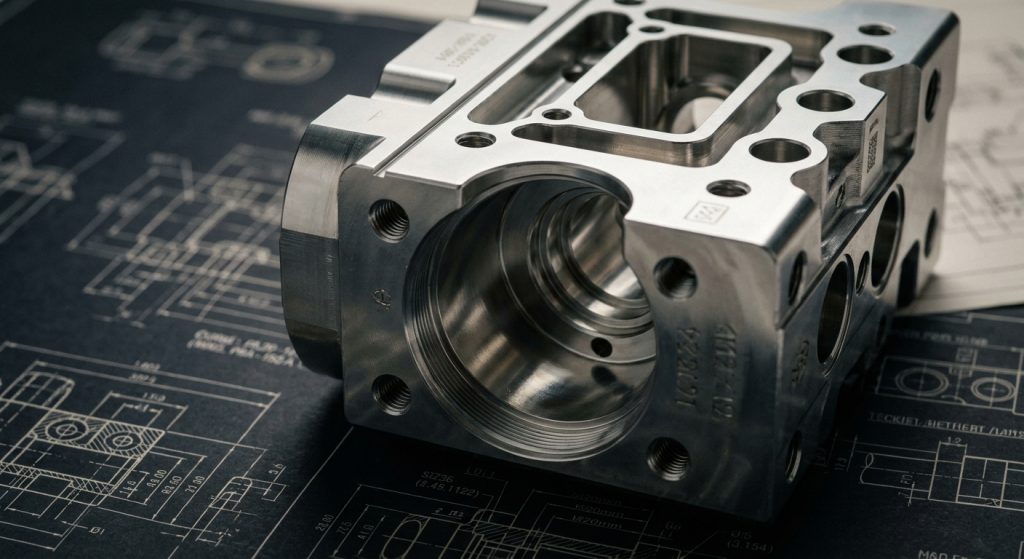
Take a part with deep holes or internal surfaces, as many mechanical components have. This is where the difference between the processes becomes tangible.
In a galvanic process, the coating is distributed according to the electric field, and inside a deep bore the field is weak. The layer becomes thicker at the edges and thinner where the field does not really reach. Electroless nickel works without current and therefore deposits uniformly over the entire geometry, also inside a pipe, as long as the liquid can flow past. For an item where tolerances must be maintained both externally and in a bore, this is often the difference between whether the coating can be used at all.
The layer thickness plays a role in the same calculation. Electroless nickel is typically applied in 5 to 25 µm depending on the requirements, and the more corrosion protection the part needs, the thicker the layer should be. These are numbers that must be considered before the tolerances are final. Even the phosphorus content is a knob that can be turned: low phosphorus content gives a hard, wear-resistant coating, while high phosphorus content gives a more ductile coating with better corrosion resistance in neutral and acidic environments.
These are the kinds of trade-offs a mechanical designer needs to know before putting the part into production.
The consultation begins in the sales department
The advice is not located in a separate consulting department. In the sales department, you work together with an experienced technician to advise on which treatment is suitable for the item. The person who gives you a quote is already thinking like the person who will later run the item through the process line. The question of shape, layer thickness and coating is asked while the drawing can still be changed.
From chemical nickel to a full treatment program
The experience goes back a long way. From the very beginning of the company, mechanical parts were treated with chemical nickel, and today the program includes a wide range of treatments for many different purposes. Chem-Tec has been working with functional surface treatment since 1986 and solves tasks with chemical, galvanic and PVD processes.
For mechanical parts, the functional properties are what it's all about: wear resistance, corrosion resistance, electrical conductivity, heat resistance and increased hardness. Electroless nickel alone covers a wide range, from fittings, valves and hydraulics to gears, gear and pump parts, and the hardness can be between approximately 475 and 800 Vickers, even higher after heat treatment. If other properties are required, coatings can be combined.
Quality that can be documented
A recommendation is only worth something if it lasts in production. The goal at Chem-Tec is a high level of quality, which is ensured by continuous quality checks before, during and after production.
This can be documented. As standard, a certificate is included with each order with the order's master data, the measured layer thickness, adhesion test and measuring equipment, and the control room has, among other things, XRF measuring equipment to verify the coatings. For larger, continuous productions, Chem-Tec sets up dedicated process lines so that the volume runs efficiently and with a stable quality level.
Three questions you can bring to the table
If you want to get the most out of the advice, bring the drawing while it can still be changed, and include the three questions:
- How does the shape of the item affect the treatment I need?
- What layer thickness does the feature require and what does it mean for my tolerances?
- Which coating provides the properties the part needs to deliver?
When the surface is considered from the start
A mechanical part, where the surface is chosen correctly from the beginning, does its job. It resists wear, keeps out corrosion, even inside the bore, and withstands the heat the process exposes it to. The series runs efficiently, the coating can be documented, and expensive compromises do not have to be made late in the process.
The items where we really make a difference are those with holes and internal surfaces. A galvanic process doesn’t always reach the corners, and chemical nickel is often the answer. But that has to be decided before the tolerances are locked, otherwise the customer ends up rebuilding.”
— Bo Hvid Mikkelsen, CEO, Chem-Tec Plating A/S
If you have a mechanical item on the drawing board, send us the drawing or a draft while the geometry can still be adjusted. We will then review it for surface technical conditions together. Call +45 75 67 92 92 or write to info@chemtec.dk.
 EN
EN  DK
DK  DE
DE