
Most people assume that metal plating requires electrical current. Hang the part in the bath, turn on the rectifier, and let the ions do the work. This is how electroplating has worked since the 19th century, and for many components in the energy, electronics, and mechanical industries, it is still the best method.
But some of the industry's most demanding coating tasks are solved without electricity. No rectifiers, no anodes, no electric field. Just chemistry.
It's called chemical plating, and at Chem-Tec Plating we've built our production around it since 1986. When we started, one of our two original production lines was running chemical nickel plating for machine components. Forty years later, the process still solves numerous tasks.
The problem with electricity
Electroplating has a physical limitation that no process control can eliminate: The electric field is never completely even.
The current concentrates at edges, corners and points. It weakens in recesses, bores and internal cavities. The result is a coating that is thickest where the geometry protrudes and thinnest where it is hidden. On a flat plate, this means almost nothing. On a hydraulic valve with internal channels, a threaded fitting or a pump housing with deep bores, it means a lot. These are everyday challenges for designers in everything from hydraulics and energy equipment to precision mechanics and medical equipment: The surfaces that need protection the most are often precisely those that the current has the hardest time reaching.
This presents the designer with a dilemma: either simplify the geometry to suit the coating process, or accept uneven protection and compensate with thicker layers, tighter controls and shorter service intervals.
There is a third option.
Take the power out of the equation
Electroless nickel is a nickel-phosphorus alloy that is deposited through a purely chemical reaction. The workpiece is immersed in a solution of nickel ions and a reducing agent, and the coating forms on all surfaces that the liquid touches. In the absence of an electric field, no field distortion occurs.
The result is a completely uniform layer, whether the surface is an outside edge, the bottom of a manhole or the inside of a pipe. If the solution can reach the surface, the coating covers it, and in the same thickness all over.
Internal surfaces receive the same protection as external surfaces. Complex geometry ceases to be a coating problem. Tolerances can be specified with peace of mind, because a 15 µm coating is 15 µm over the entire component, not an average of 8 and 22.
Phosphorus is the knob, not a detail
Here's what many buyers overlook: Electroless nickel is not one coating. It's a family of coatings, and the phosphorus content is the knob you turn to get the properties you need.
At Chem-Tec Plating we run the full spectrum:
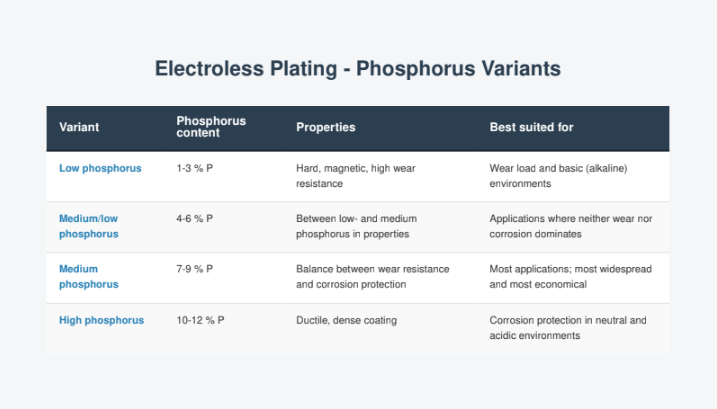
When in doubt, start with medium phosphorus. It's the workhorse, and there's a reason it's the most widely used: For most components, the trade-off between wear and corrosion is exactly what the job requires. The variants at either end of the scale are for those jobs where the environment or load pulls hard in one particular direction.
The hardness ranges from approximately 475 to 800 Vickers depending on the variant, and heat treatment can push it up further. Typical layer thickness is between 5 and 25 µm. Unlike zinc, chemical nickel does not protect as a sacrificial metal; the protection lies in the density of the layer itself, so the harsher the environment, the thicker the specification.
The coating can be applied to steel, iron, cast iron, copper, brass, aluminum, stainless steel and sintered parts. And it works well with other treatments: gold or silver on top for good contact properties, tin for solderability.
The choice between the variants is where a conversation with a surface specialist comes in. The right answer depends on whether the component lives in salt water or caustic cleaning, whether it slides against another surface, and what a mistake really costs you.
When you can't lubricate: nickel with PTFE built in
Some components cannot be lubricated. Precision mechanical parts where oil and grease do more harm than good. Welding jaws that run at temperatures a lubricant cannot survive.
For these applications, we offer chemical nickel/PTFE: a nickel-phosphorus alloy (9-12 % phosphorus) with up to 20 % PTFE particles embedded directly in the coating. The PTFE gives the surface a permanent slip effect and low friction, while the nickel matrix retains most of its hardness. The lubrication is embedded in the metal, so it cannot leak, dry out or be washed away.
The typical build-up is 3-7 µm of chemical nickel/PTFE on top of 5-20 µm of chemical nickel, with a matte finish in light to dark charcoal grey. We apply it to fittings, valves, hydraulic components, transmission and pump parts, and wear parts in steel, stainless steel, copper, brass, and aluminum. Heat treatment can further increase the hardness if the job requires it.
Black chemical nickel: function first, appearance follows
The third member of the family solves another problem: light.
Optics housings, sensor components and instrument parts often require non-reflective surfaces. Black electroless nickel provides a black, semi-gloss finish with low light reflection, and because the process is chemical, it covers internal surfaces and difficult geometries as evenly as the base treatment.
It is always applied in combination with chemical nickel, and together the two layers achieve strong corrosion protection. The treatment works on almost all metals, is suitable for screws and nuts as well as decorative items and is a practical alternative to black chrome. Same logic as the rest of the family: the chemistry does the work, and the geometry ceases to be an obstacle.
From one prototype to a million items
Capacity on paper means little if production can't deliver it. Our facility in Uldum handles items up to 550 x 250 x 550 mm as standard (larger items by arrangement), processed on a hanger or in a drum depending on the item. The series size is truly open: Our lines are built to run anything from a single item to millions.
That span means more than it might sound. It means that the prototype you send us this month and the production run you order next year go through the same processes, with the same specifications, from the same supplier, so nothing needs to be requalified as volume increases.
We have built this kind of continuity over a long time. Our first full-time employee was hired in 1989 and is still working here. In an industry where process knowledge lives in people, it is worth more than any certificate on the wall.
What you should bring to the interview with us
If you are considering chemical surface treatment for a component, three questions will get you most of the way:
First: What does the environment look like? Acidic, neutral or basic influences point to different phosphorus levels. Next: What wears out the part, corrosion, friction or both? This determines whether standard chemical nickel, a PTFE variant or a combination coating is best suited. And finally: Where are the critical surfaces? If they are internal or geometrically complex, chemical coating is most likely the answer rather than galvanic alternatives.
You don't need to show up with a finished specification. Consulting is a core task for us, and we would rather see a drawing early than a problem late.
Talk to us about your components
Chem-Tec Plating A/S has been working with chemical nickel since our first production line in 1986. Today, the treatment stands side by side with 13 other surface treatments, and this means that we recommend the process that suits your component, not the one we happen to sell.
Send us a drawing or a description of your application and we will help you find the coating that matches your requirements.
Write to: info@chemtec.dk
Call: +45 75 67 92 92
 EN
EN  DK
DK  DE
DE