
Some surfaces need to do more than just look good. A tool that is used a thousand times a week. A fixture that needs to look like itself in ten years. A mechanical component where friction costs a lifetime. For these kinds of tasks, we offer PVD coating, and in this article we tell you what the process can do and how we work with it in Uldum.
What is PVD?
PVD stands for Physical Vapor Deposition. The coating is applied under vacuum and consists of a chemical compound between metal and gas, for example chromium nitride. The result is a very thin film, typically between 0.1 and 4.0 µm, which is harder and more durable than a coating applied alone using traditional galvanic processes.
It may sound abstract, so let's take a tour through our facility.
How the process works
PVD is a dry process. There are no dissolved metal salts involved, as is known from galvanic coating. Instead, the components are mounted on a hanger and placed in a vacuum chamber together with two large metal plates, the source material. If the coating is to be chrome or black chrome, the plates are made of chrome. If it is to be gold, brass or copper, we use zirconium.
The chamber is heated and a vacuum is created. When we apply electricity to the source material, the metal is vaporized by an electric arc and the atoms are released. At the same time, a process gas such as nitrogen is introduced into the chamber, where it is converted into an electrically conductive plasma. The atoms react with the plasma and the compound condenses on the surface of the component as a homogeneous film with high bonding to the base material.
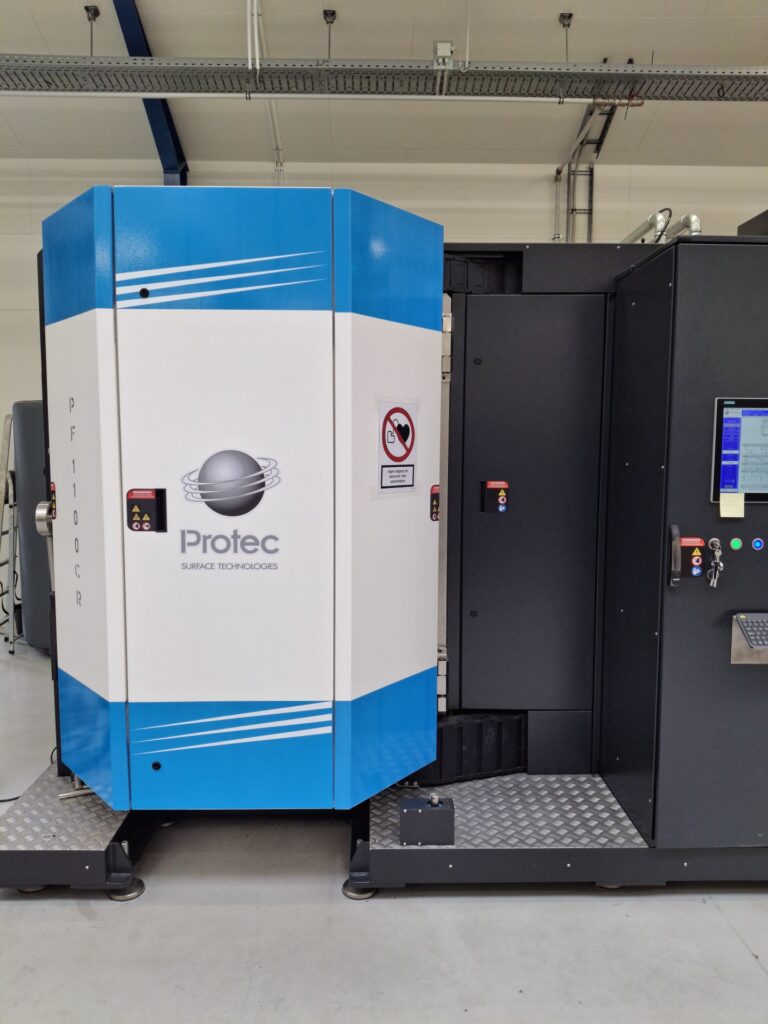
There is one detail that determines the quality: PVD is a “line-of-sight” process. The coating only hits the surfaces that are directly exposed to the source material. Therefore, our suspension rotates on two axes during the entire process, so that the coating is as uniform as possible all the way around the part.
Five colors, glossy or matte
We offer PVD in chrome, black chrome, gold, brass and copper. The coating basically has a glossy appearance. If you want a matte surface, we glass-blow the items before they enter the chamber. This way we control both color and finish in the same production flow.
The colors are used for both functional and decorative purposes: tools, mechanical components and fixtures. PVD with chrome and black chrome is also used as an alternative to electroplated bright chrome and black chrome. And because the coating with chrome, copper, brass and gold is electrically conductive, it can also be used where conductivity is a requirement.
The galvanic ace up the sleeve
Here comes the part we are most proud of. PVD can be applied directly to stainless steel and titanium. However, many items are made of copper, aluminum, steel or brass, and they require an undercoat of nickel before PVD can even be considered.
We have been working with galvanic surface treatment since 1986 and today have 12 production lines. This means that we can apply galvanic nickel or pearl nickel as an undercoat and then PVD on top, in the same house and under the same quality control. The combination opens up properties that neither process can deliver alone: corrosion protection and decorative depth from the galvanic layer, hardness and wear resistance from the PVD layer.
For you as a customer, this means one point of responsibility instead of two suppliers that need to be coordinated and two transports where the items can be damaged.
When is PVD the right choice?
The rule of thumb is simple: Choose PVD when the surface must resist wear, when friction must be reduced, or when the appearance must last for many years without changing. The coating also protects against corrosion.
In practical terms, we can process items up to 1000 mm x Ø 300 mm in chrome, copper, brass and gold, and up to 800 mm x Ø 300 mm in black chrome. If you have items in other sizes, contact us anyway. It is rarely the dimensions that end up being the problem.
Unsure if PVD is right for your subject?
The choice between PVD, galvanic and chemical surface treatment depends on the base material, functional requirements and economy, and the right answer is not always the obvious one. Call us on +45 75 67 92 92 or write to info@chemtec.dk, then we will discuss your specific topic, preferably before the construction is finalized. That's where we can make the biggest difference.
 EN
EN  DK
DK  DE
DE